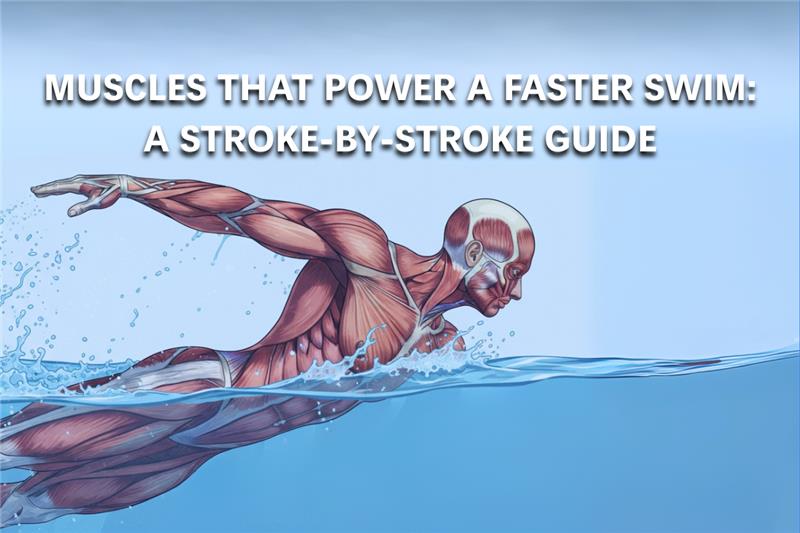
Ready to swim faster? It’s all about the muscles you engage and how efficiently you use them. Each swim stroke—freestyle, backstroke, breaststroke, or butterfly—relies on specific muscle groups to boost speed and performance. Below, we break down the key muscles for each stroke, explain their role in swimming faster, and provide science-backed training insights. Let’s dive in!
Freestyle: The Speed Machine
Freestyle, or front crawl, is the fastest stroke, blending full-body power with streamlined motion.
Key Muscles at Work:
This lactate accumulation can have both short-term and long-term implications:
- Latissimus Dorsi (Lats): : These broad back muscles drive the underwater pull, propelling you forward.
- Pectoralis Major (Pecs): Chest muscles engage during the catch and pull, moving water efficiently.
- Deltoids:Shoulder muscles stabilize arms during pull and recovery phases.
- Triceps: Extend elbows underwater, enhancing pulling power.
- Core (Abs, Obliques, Transverse Abdominis): Maintains streamline, reduces drag, and aids torso rotation.
- Quadriceps & Hamstrings: Power the flutter kick for propulsion and balance.
- Glutes:Drive hip extension in the kick for added force.
Why They Matter for Speed:
Lats and teres muscles generate pulling power, while posterior deltoids ensure smooth recovery to reduce drag. The flutter kick, driven by hip flexors, quads, and glutes, significantly boosts speed (Hollander et al., 1988). A strong core prevents rolling, enabling efficient gliding.
Breaststroke: The Leg-Driven Stroke
Breaststroke relies heavily on leg power and technique, with its signature whip kick.
Key Muscles at Work:
- Pectoralis Major: Powers the arm pull, sweeping water inward.
- Latissimus Dorsi: Supports the pull, particularly during the insweep.
- Quadriceps & Adductors: Drive the whip kick, with adductors pulling legs together for thrust.
- Glutes & Hamstrings: Extend hips and flex knees for a powerful kick.
- Core: Stabilizes body during the glide, reducing drag.
- Calves (Gastrocnemius & Soleus): Flex ankles during the kick, enhancing propulsion.
Why They Matter for Speed:
The breaststroke kick generates up to 60% of propulsion (Maglischo, 2003). Strong quads, adductors, and glutes make the whip kick explosive, while pecs and lats ensure a solid arm pull. A streamlined core and flexible calves optimize glide and kick efficiency for faster times.
Butterfly: The Ultimate Power Stroke
Butterfly demands strength, coordination, and stamina, engaging nearly every muscle group.
Key Muscles at Work:
- Latissimus Dorsi & Pectoralis Major: Power the simultaneous arm pull, moving large volumes of water.
- Deltoids: Stabilize shoulders and aid arm recovery.
- Triceps: Extend elbows during the pull for maximum force.
- Core (Abs, Obliques, Erector Spinae): Drive the dolphin-like undulation, maintaining streamline.
- Hip Flexors & Glutes: Power the dolphin kick, lifting the body and adding propulsion.
- Quads & Hamstrings: Support the kick, driving leg motion.
Why They Matter for Speed:
Lats and pecs deliver a powerful pull, while a strong core ensures tight, efficient undulation. The dolphin kick, fueled by hip flexors and glutes, adds significant speed (Barbosa et al., 2010). Precise muscle coordination is crucial for maintaining momentum and flying through the water.
Power Up Your Training
To swim faster, target these muscles with a mix of dryland and pool training:
- Upper Body :Pull-ups, lat pulldowns, and bench presses strengthen lats, pecs, and triceps.
- Core: Planks, Russian twists, and leg raises build a drag-reducing midsection.
- Lower Body: Squats, lunges, and calf raises enhance kick power, especially for breaststroke and butterfly.
- Flexibility: Stretch ankles and hips for fluid, effective kicks.
Combine dryland workouts with stroke-specific pool drills to refine technique. Stronger muscles and better form will have you slicing through the water faster. Happy swimming!
Citations
1) Toussaint, H. M., & Beek, P. J. (1992). Biomechanics of competitive swimming: A review. Sports Medicine, 13(1), 8–24. https://doi.org/10.2165/00007256-199213010-00002
Contribution of the legs to propulsion in front crawl swimming. International Series on Sport Sciences, 18, 320–326. https://link.springer.com/chapter/10.1007/978-1-4684-5904-3_34
3) Maglischo, E. W. (2003). Swimming Fastest. Human Kinetics. https://www.humankinetics.com/products/swimming-fastest
4) Barbosa, T. M., et al. (2010). Biomechanical analysis of the butterfly stroke. Journal of Sports Sciences, 28(11), 1195–1206. https://doi.org/10.1080/02640414.2010.507657