Month: September 2025

Categories Swim Community

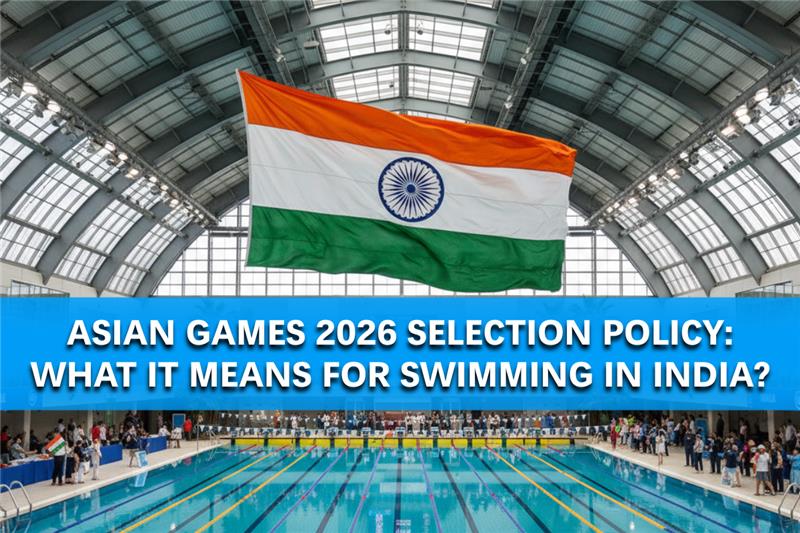
Asian Games 2026 Selection Policy: What It Means for Swimming in India?

The Sports Ministry’s recent directive for the 2026 Asian Games has made headlines: only athletes and teams with a “real chance of winning medals” will be cleared to participate.

For measurable sports like swimming, this means Indian swimmers must match or surpass the 6th-place timing from the previous Asian Games in officially recognized competitions within the last 12 months. No longer can athletes participate just for exposure, or even at their own cost—the government will only support those with genuine podium prospects.

This policy forces us to ask some tough questions:

  • How many of our swimmers are consistently benchmarked against international standards?
  • Do our academies have the tools to transparently track progress toward medal-winning performances?
  • Are we preparing swimmers for podiums, or are we just training them for local competitions?
The Heartbreak behind the Numbers

Behind every swimmer who misses the benchmark, there’s a story—of early morning practices, parents juggling finances, coaches struggling with limited pool time, and athletes racing with more determination than resources.

Now, imagine telling such a swimmer: “You can’t represent your country, because we don’t think you can win a medal yet.”

It’s harsh, but it’s also the reality. And unless we rethink how we build the swimming ecosystem in India, many deserving athletes will never even get the chance to step on that starting block at the Asian Games.

This decision, while pragmatic, has stirred mixed emotions in the Indian sports ecosystem. Let’s break it down:

The Challenge for Indian Swimming Ecosystem

Swimming in India has always faced unique hurdles:

  • Uneven training infrastructure – Elite pools are concentrated in a few metros.
  • Lack of structured data – Unlike athletics or shooting, swimming often lacks systematic tracking of performance benchmarks.
  • Limited exposure – Many swimmers don’t get consistent opportunities to compete internationally, making it harder to meet selection standards.
  • Gap between grassroots and elite – Promising young swimmers may miss crucial international exposure before they reach peak performance age.

With the new policy, only medal-ready swimmers will go to the Asian Games. That raises the bar but also risks leaving behind a generation of swimmers who could develop into future champions with the right support.

How Technology Can Bridge This Gap

This is exactly where digital solutions like SwimProHub Academy360° come into play.

  1. Benchmark Tracking Made Easy:The app integrates with smartwatches and training logs to track swimmers’ times against qualifying benchmarks. Coaches and academies can instantly see whether their swimmers are approaching, matching, or falling short of qualifying standards.
  2. Structured Training & Assessment: SwimProHub Academy360° enables academies to set up standardized training programs, skill assessments, and certifications. This ensures swimmers across India progress under a uniform framework, closing the gap between grassroots and elite levels.
  3. Transparent Data for Federations : With verified performance data stored securely on the platform, federations and selectors get a clear, unbiased picture of swimmer development. This makes selection decisions more transparent and evidence-driven.
  4. Exposure beyond Local Pools: Through digital assessments, trials and competitions data on SwimProHub Academy360°, swimmers can compare progress data and monitor their overall performance—even if they don’t have access to high-profile competitions every month.
  5. Building a Medal-Ready Ecosystem: By combining training, diet data, health metrics, performance analytics, certification, and communication in one platform, SwimProHub Academy360° can help create a pipeline of swimmers who are truly medal-ready—not just in 2026, but for decades to come.
  6. Coach & Academy Empowerment: Instead of working in silos, coaches gain tools to prepare swimmers systematically for medal-level competitions by removing guesswork and bias. SwimProHub Academy360° provides dashboards, reports, performance analytics, and much more which uplifts the swimming ecosystem in India.
A Way Forward

The Sports Ministry’s policy is clear: India must send only those with real medal potential. For swimming, this should not be seen as a setback, but as a call to action.

If India wants more swimmers on the Asian Games podium, the ecosystem needs to invest in:

  • Technology-driven training platforms like SwimProHub Academy360°.
  • Standardized performance tracking across academies.
  • Early benchmarking against international standards.
  • Transparency and inclusivity, so no talent is overlooked.

This is not just about medals. It’s about building confidence, credibility, and a clear pathway for every swimmer in India.

The Bigger Picture

The Ministry’s rule is not just about limiting participation—it’s about raising standards. But raising standards without fixing the grassroots pipeline will only shrink the dream for thousands of swimmers.

Policies will come and go, but the long-term solution for Indian swimming lies in systematic training, transparent benchmarking, and athlete development powered by technology.

If India wants to move from participation to podiums in swimming, technology-enabled ecosystems like SwimProHub Academy360° aren’t optional—they’re essential.

Because medals aren’t won on race day. They’re built every day in our pools—through consistency, data, and vision.

Citations & References
  1. Selection criteria for 2026 Asian Games: Sports Ministry bans additional support staff even if govt. not billed, Times of India — timesofindia.indiatimes.com The Times of India
  2. Only athletes, teams with medal possibility for 2026 Asian Games, says Sports Ministry, Hindustan Times — hindustantimes.com DD News
  3. Govt notifies selection criteria for Asian Games 2026, other multi-sport events, DD News — ddnews.gov.in DD News
  4. Selection criteria for 2026 Asian Games: Ministry bans additional support staff, NDTV Sports — sports.ndtv.com NDTV Sports
  5. 2026 Asian Games: Only medal-contending athletes to be selected, extra support staff banned, Economic Times — economictimes.com The Economic Times
  6. Sports Ministry sets strict benchmarks for 2026 Asian Games selection, The Statesman — thestatesman.com The Statesman
  7. Ministry of Youth Affairs & Sports brings out Selection Criteria …, Press Information Bureau (via PIB site) – pib.gov.in
Categories Swimmer Nutrition

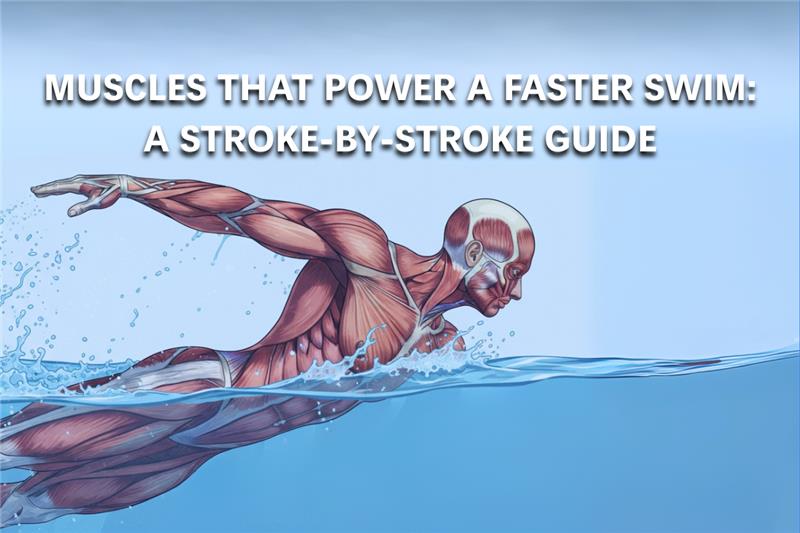
Muscles That Power a Faster Swim: A Stroke-by-Stroke Guide

Ready to swim faster? It’s all about the muscles you engage and how efficiently you use them. Each swim stroke—freestyle, backstroke, breaststroke, or butterfly—relies on specific muscle groups to boost speed and performance. Below, we break down the key muscles for each stroke, explain their role in swimming faster, and provide science-backed training insights. Let’s dive in!

Freestyle: The Speed Machine

Freestyle, or front crawl, is the fastest stroke, blending full-body power with streamlined motion.

Key Muscles at Work:

This lactate accumulation can have both short-term and long-term implications:

  • Latissimus Dorsi (Lats): : These broad back muscles drive the underwater pull, propelling you forward.
  • Pectoralis Major (Pecs): Chest muscles engage during the catch and pull, moving water efficiently.
  • Deltoids:Shoulder muscles stabilize arms during pull and recovery phases.
  • Triceps: Extend elbows underwater, enhancing pulling power.
  • Core (Abs, Obliques, Transverse Abdominis): Maintains streamline, reduces drag, and aids torso rotation.
  • Quadriceps & Hamstrings: Power the flutter kick for propulsion and balance.
  • Glutes:Drive hip extension in the kick for added force.

Why They Matter for Speed:

Lats and teres muscles generate pulling power, while posterior deltoids ensure smooth recovery to reduce drag. The flutter kick, driven by hip flexors, quads, and glutes, significantly boosts speed (Hollander et al., 1988). A strong core prevents rolling, enabling efficient gliding.

Breaststroke: The Leg-Driven Stroke

Breaststroke relies heavily on leg power and technique, with its signature whip kick.

Key Muscles at Work:

  • Pectoralis Major: Powers the arm pull, sweeping water inward.
  • Latissimus Dorsi: Supports the pull, particularly during the insweep.
  • Quadriceps & Adductors: Drive the whip kick, with adductors pulling legs together for thrust.
  • Glutes & Hamstrings: Extend hips and flex knees for a powerful kick.
  • Core: Stabilizes body during the glide, reducing drag.
  • Calves (Gastrocnemius & Soleus): Flex ankles during the kick, enhancing propulsion.

Why They Matter for Speed:

The breaststroke kick generates up to 60% of propulsion (Maglischo, 2003). Strong quads, adductors, and glutes make the whip kick explosive, while pecs and lats ensure a solid arm pull. A streamlined core and flexible calves optimize glide and kick efficiency for faster times.

Butterfly: The Ultimate Power Stroke

Butterfly demands strength, coordination, and stamina, engaging nearly every muscle group.

Key Muscles at Work:

  • Latissimus Dorsi & Pectoralis Major: Power the simultaneous arm pull, moving large volumes of water.
  • Deltoids: Stabilize shoulders and aid arm recovery.
  • Triceps: Extend elbows during the pull for maximum force.
  • Core (Abs, Obliques, Erector Spinae): Drive the dolphin-like undulation, maintaining streamline.
  • Hip Flexors & Glutes: Power the dolphin kick, lifting the body and adding propulsion.
  • Quads & Hamstrings: Support the kick, driving leg motion.

Why They Matter for Speed:

Lats and pecs deliver a powerful pull, while a strong core ensures tight, efficient undulation. The dolphin kick, fueled by hip flexors and glutes, adds significant speed (Barbosa et al., 2010). Precise muscle coordination is crucial for maintaining momentum and flying through the water.

Power Up Your Training

To swim faster, target these muscles with a mix of dryland and pool training:

  • Upper Body :Pull-ups, lat pulldowns, and bench presses strengthen lats, pecs, and triceps.
  • Core: Planks, Russian twists, and leg raises build a drag-reducing midsection.
  • Lower Body: Squats, lunges, and calf raises enhance kick power, especially for breaststroke and butterfly.
  • Flexibility: Stretch ankles and hips for fluid, effective kicks.

Combine dryland workouts with stroke-specific pool drills to refine technique. Stronger muscles and better form will have you slicing through the water faster. Happy swimming!

Citations

1) Toussaint, H. M., & Beek, P. J. (1992). Biomechanics of competitive swimming: A review. Sports Medicine, 13(1), 8–24. https://doi.org/10.2165/00007256-199213010-00002

Contribution of the legs to propulsion in front crawl swimming. International Series on Sport Sciences, 18, 320–326. https://link.springer.com/chapter/10.1007/978-1-4684-5904-3_34

3) Maglischo, E. W. (2003). Swimming Fastest. Human Kinetics. https://www.humankinetics.com/products/swimming-fastest

4) Barbosa, T. M., et al. (2010). Biomechanical analysis of the butterfly stroke. Journal of Sports Sciences, 28(11), 1195–1206. https://doi.org/10.1080/02640414.2010.507657

Categories Swimming Education

India Makes a Splash: Hosting the 11th Asian Aquatics Championships 2025

Lactic acid is a term that often surfaces in the world of competitive sports, especially in high-intensity disciplines like swimming. While it’s commonly associated with muscle fatigue and soreness, the science behind lactic acid is more nuanced. For swimmers, whether amateur or elite, understanding how lactic acid affects performance, recovery, and training can be a game-changer.

What is Lactic Acid?

Lactic acid, or more accurately, lactate, is a byproduct of anaerobic metabolism. During intense exercise, when the body’s demand for energy exceeds the oxygen supply, the muscles begin to generate energy through a process called anaerobic glycolysis. This results in the production of lactate along with hydrogen ions (H+), which can lower the pH level in muscle cells, leading to a more acidic environment.

Contrary to earlier beliefs, lactic acid is not the direct cause of muscle fatigue. Instead, the accumulation of hydrogen ions that accompany lactate production interferes with muscle contraction and contributes to the burning sensation experienced during strenuous effort.

Lactic Acid and Swimming Performance

Swimming, particularly in sprint and middle-distance events, relies heavily on both aerobic and anaerobic energy systems. During races such as the 100m or 200m freestyle, the anaerobic system becomes dominant, resulting in high levels of lactate production.

This lactate accumulation can have both short-term and long-term implications:

  • Short-term: As lactate builds up, swimmers experience fatigue and a decrease in performance. The body’s inability to clear lactate quickly enough during intense sets can impair muscle efficiency.
  • Long-term: Over time, with proper training, the body becomes better at buffering and clearing lactate. This adaptation, known as the lactate threshold improvement, allows swimmers to perform at higher intensities without fatigue setting in too early.
Training and the Lactate Threshold

The lactate threshold is the exercise intensity at which lactate begins to accumulate significantly in the blood. Training to improve this threshold is crucial for swimmers, especially in events that require sustained high-speed swimming.

Key training methods include:

  • Lactate Tolerance Training: This involves repeated bouts of high-intensity swimming with rest intervals that are long enough to allow partial recovery. The goal is to train the body to tolerate and buffer high levels of lactate.
  • Lactate Clearance Sets: These involve moderate-intensity swims that promote the use of lactate as an energy source during active recovery, enhancing the body’s ability to clear it.
  • Aerobic Base Training: A strong aerobic foundation increases the efficiency of the cardiovascular system, which supports lactate clearance and delays its accumulation during races.
Recovery and Lactate

Clearing lactic acid post-workout is essential for effective recovery. Active recovery—such as low-intensity swimming or stretching—facilitates blood flow and helps flush out accumulated lactate. Other recovery methods include:

  1. Hydration: Adequate water intake supports metabolic processes, including lactate removal.
  2. Nutrition: Carbohydrates help replenish glycogen stores, while protein supports muscle repair.
  3. Massage and hydrotherapy: These promote circulation, aiding in the removal of metabolic byproducts.
Misconceptions About Lactic Acid

A common myth is that lactic acid causes delayed onset muscle soreness (DOMS). In reality, DOMS is due to microscopic muscle damage and inflammation, not lactate buildup. Lactate levels typically return to baseline within 30–60 minutes after exercise, whereas DOMS peaks 24–72 hours later.

Conclusion

Understanding lactic acid and how it interacts with the body’s energy systems is critical for swimmers aiming to improve performance. By incorporating lactate-specific training and recovery strategies, swimmers can increase their efficiency, delay fatigue, and gain a competitive edge. Coaches and athletes should consider lactate response as a vital part of their training plan, not just as a challenge to overcome, but as a pathway to greater endurance and speed.

WhatsApp Channel